

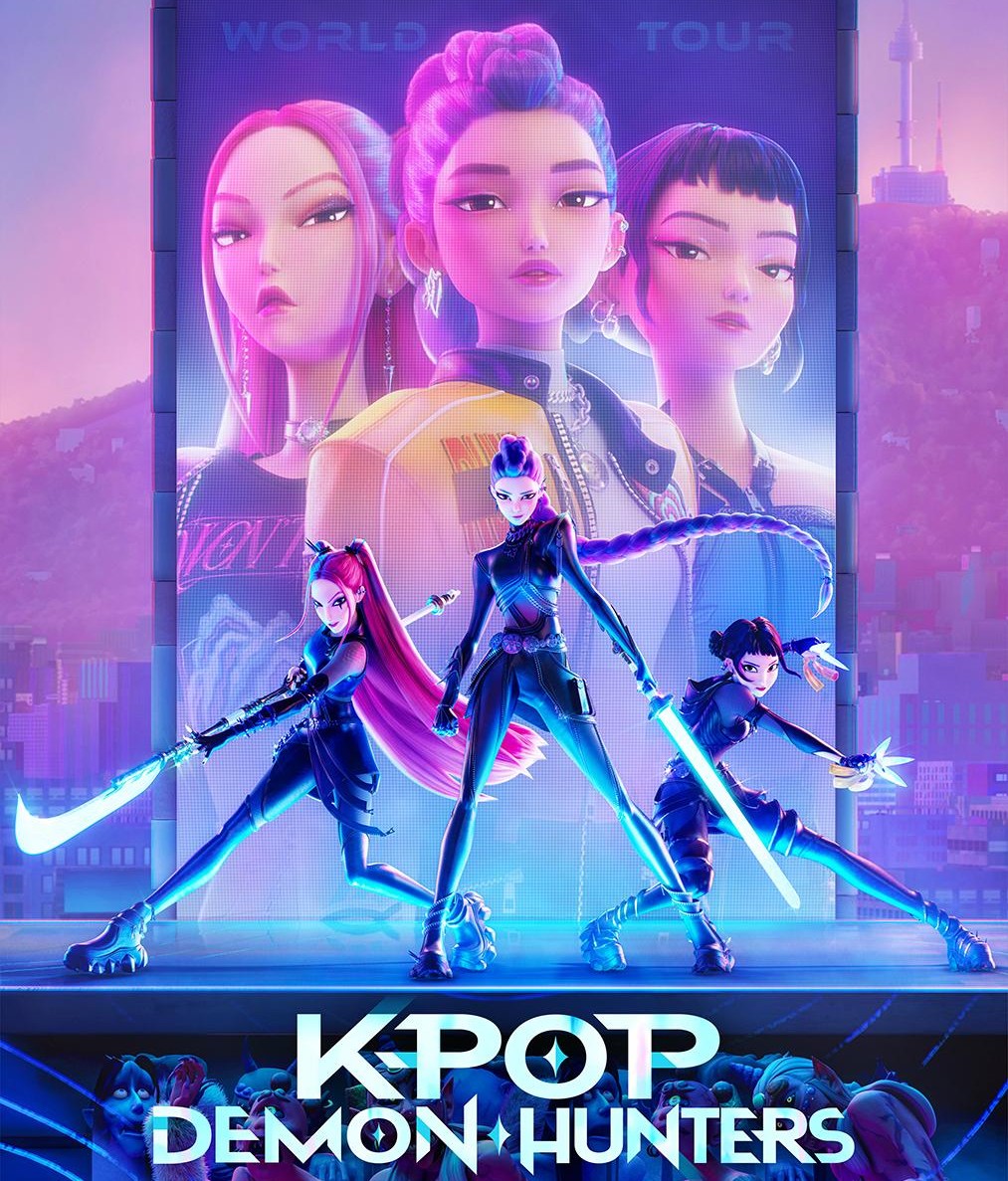

Let’s get this out of the way: I loved it, and I’m not sorry. On paper, an animated musical about a demon-slaying female Korean pop trio confronted on the eve of their greatest triumph by the hellish designs of a demon boy band bent on destroying the protective barrier that Huntr/x, with their lovely voices and glowing weapons, is sworn to maintain—should not appeal to any self-respecting, conservative, forty-something, manly man. But in storytelling, as in demon destruction, execution is everything.
While the foregoing synopsis suggests something thin and superficial, K-Pop Demon Hunters is a tightly plotted and thematically rich animated musical whose imagery, dialogue, and lyrics make for a catchy counternarrative to nihilistic and gnostic trends in contemporary pop culture. K-Pop has things to say without ever feeling like it’s trying to “say something,” that is, beat the viewer over the head with some “relevant” message or make the plot a mere vessel for the same. But its themes are ultimately compatible with a Christian sense of sin, guilt, love, redemption, and spiritual warfare.
The story opens on Rumi, Mira, and Zoey, the latest trio in a long line of musical fighters whose songs maintain the Honmoon barrier and whose ultimate goal, soon to be realized, is its transformation into the Golden Honmoon, a permanent bulwark against the Devil-like Gwi-Ma and his demon hordes. These “demons” are fallen human souls, slaves to Gwi-Ma, who controls them forever with his cynical, intrusive voice, constantly recalling their sins and failures. He is the Accuser, bent on convincing human beings that they are worthless and evil and would be better off with him. Now struggling with her overtaxed voice, Huntr/x’s lead singer Rumi also conceals a secret that could undo everything. At this crucial moment, a demon boy band arrives to steal their fans and damage the barrier, and the stage is set for a spiritual and psychological showdown.
Before exploring this film in detail, please note that its demons are a hybrid of Christian and native Korean concepts. They are unambiguously bad, and this film avoids any sympathy with the Devil, yet most do not appear to be fallen angels but rather people that have surrendered to despair and who are therefore bent on dragging others down into their misery. Only Gwi-Ma himself corresponds to the Christian idea of Satan. Therefore, killing demons is portrayed as a virtuous thing, because they’re not “misunderstood”; they’re evil. But K-Pop’s demons do double duty as metaphors for the consequences of believing the lie that one’s sins define one’s being.
It’s a difficult line to skate, but unlike certain directors—I’m looking at you, Peter Jackson—Maggie Kang, Chris Appelhans, and their animators did a great job of making the forces of good look cooler than those of evil (except, of course, when showing the lure of evil was their explicit goal). The standard demon here is appropriately wicked, yet also absurd and cartoonish enough to repel young viewers without leaving them either too disturbed or too intrigued. The narrative floats the possibility that one of these “demons” might be redeemable, but this dim hope isn’t presented as a challenge to Christian soteriology, since K-Pop’s Korean underworld is more like Hades than Hell.
With these distinctions in mind, let us turn to the themes and qualities that have made K-Pop Demon Hunters resonate with so many people.
A True Musical
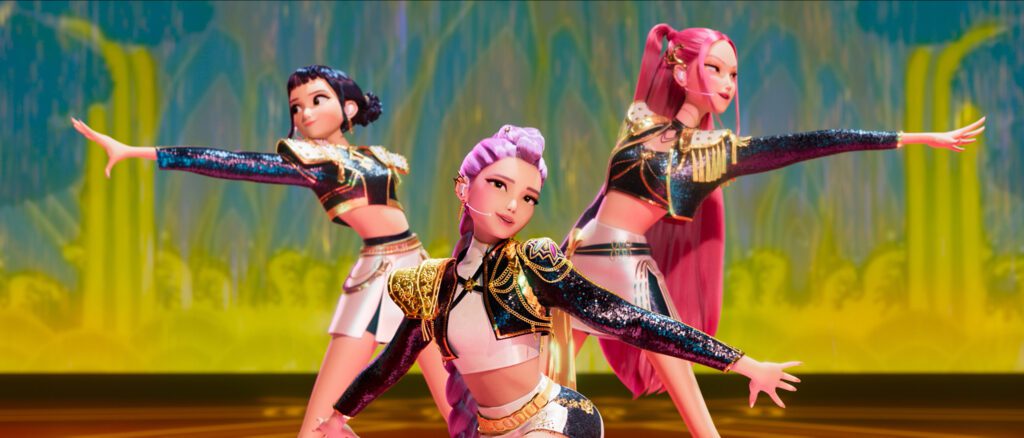
It wasn’t enough for the filmmakers that every song in this movie should have that “brainworm” quality of a ’90s pop single or that the soundtrack as a whole possess the qualities of a chart-topping album. The lyrics all work together and play off each other, forwarding plot, characterization, and themes. Sometimes this is brilliantly done. The songs are all technically demanding, and most include lyrics that seamlessly blend Korean phrases into their beat and rhyme schemes alongside English. Every word serves its song but also develops the narrative’s themes.
In effective art, as in living things, each part serves its particular purpose and also the whole. K-Pop’s songs aren’t just catchy one-offs; they’re in dialogue with each other and with the film’s themes and motifs. For example, consider how the demon Saja Boys’ “Your Idol” differs from but builds upon “Soda Pop,” while Huntrix’s “This Is What It Sounds Like” responds to “Your Idol” but also references “Takedown.” “Soda Pop” sounds light-hearted (though its lyrics subtly suggest predation), while “Your Idol” shows evil unmasked, its seductive, destructive motives on full display. One line in the chorus flips from “Don’t you know I’m here to save you?” to “No one is coming to save you.” “Your Idol” comes at a moral low point for the protagonists, but it’s followed by Rumi’s triumphant counter-punch, “This Is What It Sounds Like,” an uplifting and redemptive power ballad that refutes evil root and branch. I also loved the lyrical contrast here to an earlier episode where the band struggled to write a new song, “Takedown.” Though extremely catchy, this diss track makes Rumi uncomfortable because she perceives that its hostile lyrics could be redirected at her—as indeed they are, later in the film—and the girls’ quarrel about these lyrics becomes a proxy for the division being sown among them by Rumi’s hidden shame. Their conflict also works as a critique of the diss track itself, which is such a common feature of contemporary pop and rap. Thus, when Rumi belts out “This Is What It Sounds Like” in the finale, these lyrics pack a lot of punch:
Why did I cover up the colors stuck inside my head?
I should have let the jagged edges meet the light instead.
Show me what’s underneath.
I’ll find your harmony.
The song we couldn’t write
This is what it sounds like.
Though “Golden” is bound to be most viewers’ favorite track, there are half a dozen strong songs in the film. I particularly enjoyed the sequences featuring “How It’s Done” and “Free.” The former is a masterclass in establishing setting, while the latter effortlessly and smoothly carries a metric ton of thematic and character weight. The way the songs all build off each other and are consummated in the final track shows evidence of careful craftsmanship and tight writing, whatever one’s feelings about pop music as a medium.
Unapologetic Femininity and Old-Fashioned Storytelling
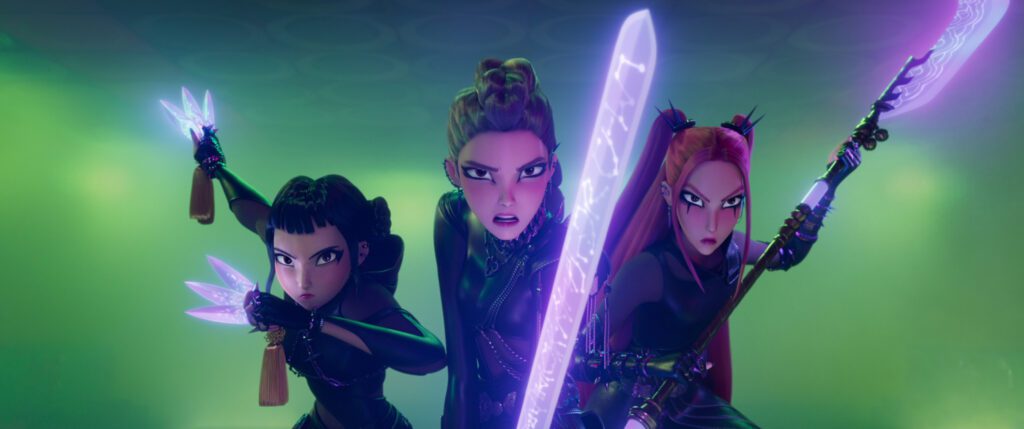
The success of Sony’s Animation’s K-Pop Demon Hunters seems like a refutation of several contemporary narrative trends and the implicit doctrines behind them, namely that a strong female character should be masculine, that modern stories should be subversive (not just morally but even structurally), and that in order to enjoy a book or film, the viewer must be able to “see themselves in it,” that is, recognize the main characters as representatives of their own race or sex. Meanwhile, K-Pop is traditional storytelling in every sense of the word. The female protagonists are decidedly women, and their girly-ness is natural and, in this cultural hour, frankly refreshing. Though they wield blades (sparkly ones), they also wear heels and even take time to apply makeup as they plunge through the skies from a burning aircraft. And while the boy band types they find attractive are not exactly the sort to be running Ironman courses, their “pretty boy” qualities are more the butt of a joke we’re all in on than some new ideal of gentle masculinity. The female protagonists aren’t Mary Sues, nor overpowered girl-bosses with no real flaws, prevented from realizing their full awesomeness only by some narrative patriarchy-proxy (see Captain Marvel, Rey from Disney’s Star Wars, and a dozen recent films). Rumi, Mira, and Zoey have real flaws and must overcome real challenges in the course of this classic hero’s journey. There’s also nothing in this film that suggests women can only thrive as women by rejecting their femininity, by aping masculinity, or by putting all the stupid men in their place.
I did not see myself in these girly, silken-voiced fashionistas or in their interpersonal drama, their ramen binging, couch sessions, etcetera, but I enjoyed their different personalities and the way each embodied womanhood in a unique way. I found them, at the same time, admirable and other. They were interesting as women because they were so decidedly not men, not me, which is the way admiration is supposed to work. Of course, one can always relate to those elements universal to every human struggle, the hero’s journey, so to speak, built into every man or woman’s experience. But it is precisely this authentic form of “seeing yourself” in the characters that apostles of the Identity School of Writing (my term) tend to subvert.
K-Pop Demon Hunters subverts this subversion by telling a tale of good triumphing over evil with admirable economy and pacing. The basic world-building is clean, the setting and stakes are quickly established, and the narrative and character arcs build by progressive complication toward a harrowing crisis, a thrilling climax, and a resolution that satisfyingly answers the problems the narrative posed. Where this story “subverts expectations,” it does so not by attacking its own story structure or its characters’ stated motivations, but rather by paralleling the constructive subversion of the Cross.
Sin, Shame, and Human Value
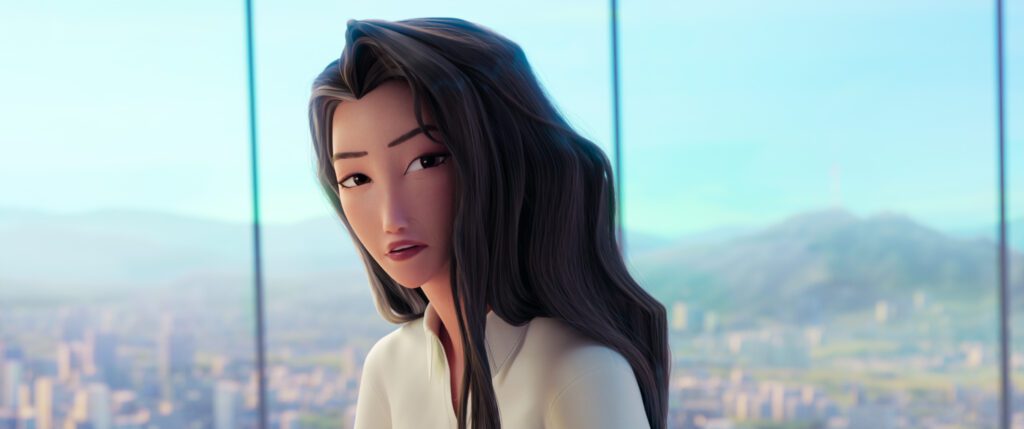
Paul speaks in Corinthians of a sorrow or repentance that leads to death (2 Cor. 7:10; also, Acts 13:46), a conviction that one is unworthy of being saved, and he contrasts this hopeless sadness with a holy sorrow that leads to life and an increase in true freedom. While evil makes its initial appeal with a silkened tongue and glittering lights, its final and permanent message is one of accusation and bitter self-hatred. Evil seems to offer an increase of life and freedom, only to turn the tables when guilt and the effects of sin sear the conscience and damage relationships beyond apparent repair. This shift from promised freedom to final enslavement is put quite well in the demon Saja Boys’ “Your Idol”:
Know I’m the only one right now
I will love you more when it all burns down
More than power, more than gold
Yeah, you gave me your heart, now I’m here for your soul
I’m the only one who’ll love your sins
Feel the way my voice gets underneath your skin…
Gimme your desire
I can be the star you rely one…
Don’t you know I’m here to save you?
Now we runnin’ wild
Yeah, I’m all you need, I’ma be your idol…
Living in your mind now
Too late, ‘cause you’re mine now
I will make you free
When you’re all a part of me…
You can’t look away
No one is coming to save you…
A person caught in this snare can only escape through honest self-examination made in the light of Love Itself, with the understanding that Love is more powerful than Death. He must fully and honestly accept the reality of sin, whether personal, constitutional (Original Sin), or its temporal effects, some of which leave enduring or even permanent marks. But he must do so with his eyes focused in hope on the source of Being. Yet even repented evil does real damage, the effects of which must somehow be re-woven into the pattern of salvation. Recall that the risen Christ still bears the marks of the Cross, though these marks now have a new meaning.
The sinner must believe that his real value and identity are deeper than the jagged “patterns” that sin has tattooed upon his soul. In the words of Pope St. John Paul II, “We are not the sum of our weaknesses and failures; we are the sum of the Father’s love for us and our real capacity to become the image of His Son.” While keeping things on the level of human relationships and psychology, Huntr/x’s musical response to “Your Idol” still has much to say about the need for honest self-examination and confession of one’s sins as the path to escaping the snares of death:
Nothing but the truth now
Nothing but the proof of what I am
The worst of what I came from
Patterns I’m ashamed of
Things that even I don’t understand
I tried to fix it
I tried to fight it
My head was twisted
My heart divided
My lies all collided
I don’t know why I didn’t trust you to be on my side
I broke into a million pieces, and I can’t go back
But now I’m seeing all the beauty in the broken glass
The scars are part of me, darkness and harmony
My voice without the lies, this is what it sounds like…
We’re shattering the silence, we’re rising, defiant
Shouting in the quiet, “You’re not alone!”
We listened to the demons, we let them get between us
But none of us are out here on our own!
Spiritual Discernment and Spiritual Warfare
Surprisingly, K-Pop Demon Hunters has a lot to say about the psychological dimensions of spiritual warfare. Since the devilish Gwi-Ma uses intrusive thoughts, images, and feelings to harm and control people, characters must learn to recognize and reject this voice. “One of the hunters bears my mark. She has shame,” says Gwi-Ma. “We can use it to destroy her.” Gwi-Ma controls the male lead, Jinu, by constantly reminding him of his cowardice and betrayal. When Rumi naively comments that demons don’t have feelings, Jinu corrects her: “Is that what you think? That’s all demons do—feel! Feel our shame and our misery. That’s how Gwi-Ma controls us.” Later on, Rumi tries to save Jinu as he despairs over his sins, listening to the voice that would define him only in terms of the wrongs he committed. “I left them…” he says, recalling his great sin. “All we get to do is live with our misery. That’s all we deserve.” “But that’s not all you are,” replies Rumi. “This is just your demon talking.”
As previously mentioned, Rumi senses something disordered in the lyrics of the band’s new song, “Takedown.” That song’s negative tone seems to play into the demon’s strategy rather than undermine it. It’s imbued with an attractive vindictiveness that almost feels like righteous anger. But hatred cannot be the force that defeats hatred. As Jinu puts it, “If hate could defeat Gwi-Ma, I would have done it a long time ago.” When her bandmates are on the ropes, Rumi counsels them to recognize the source of their destructive thoughts, saying, “All these fears … that’s the demons talking.” The film thus urges an attitude of discernment toward the voices we hear, internally or externally, and counsels us to consider both their source and the end toward which they tend. We should not dialogue with despair, nor assume good intentions from voices hell-bent on our destruction. It’s one thing to entertain the possibility of salvation for a character like Jinu, who shows some goodwill, but quite another—as Rumi discovers when she tries to extend sympathy to a demon imp—to give dogs what is holy or cast pearls before swine. Evil is real, and its voice cannot be trusted.
Humor, Style, and Miscellany
Though it engages some serious themes, K-Pop Demon Hunters is often hilarious. It celebrates Korean pop music but winks knowingly at its excesses. The film is sprinkled with light critiques of hyper-emotional fanbases, shallow competitiveness, and the way phones and social media can drive a bubble culture. “Every snowflake is special,” intones an award show host, “but one snowflake is probably the best.” “The internet is never wrong!” proclaims Huntr/x’s manager, Bobby, glued to his phone and to what he thinks it is telling him. But most of the film’s laughs come through the dialogue and through situational humor, which flow from the characters’ established personalities or from the general awkwardness of life. I also quite enjoyed the moments when the film went full anime, with characters’ eyes growing ludicrously large and shooting out popcorn, or their cheeks bulging as they gobbled down ramen noodles. There’s something wholesome about K-Pop Demon Hunters’ willingness to have fun with its medium while never attacking or subverting it.
Though distributed as a Netflix original film, the studio behind K-Pop, Sony Pictures Animation, also gave us the Spider-Verse movies. The quality is thus very high, though the style is more quirky, somewhere between realism and cartoonishness, and freely jumps between these poles as the situation demands. The production value on the music is top-notch, and the songs are technically demanding and would require a great deal of work and voice training to pull off.
The storytelling, as already noted, is also extraordinarily smooth and economical. No scene is wasted, and the film handles exposition effortlessly, working its world-building into scene beats and natural dialogue and needing only a very brief introductory voiceover to get the story rolling. At 96 minutes, the movie flies by, but each main character feels distinct and complex. For example, the tension between Rumi’s need for rest and her artistic passion for the work gives her depth and realism and yet is handled in a few deft strokes of the screenwriters’ pens. World-building details like the dynamics of Rumi’s patterns or the causal relationship between Huntr/x’s weapons and their fans’ inspiration level are never explained but are there to be noticed. The Saja Boys have fewer character moments, but most manage to feel like distinct characters. Their band logo even changes at a critical moment from a lion (“saja” means “lion”) to something resembling a devil with horns (“saja” also refers to a dark entity associated with death in Korean mythology.) One recalls here Peter’s words from Scripture, “Your enemy the Devil is prowling around like a roaring lion, looking for someone to devour” (1 Pet. 5:8). A movie with this much going on under the hood could easily feel clunky, ponderous. Instead, it goes down as smoothly as, well, soda pop.
Caveats
K-Pop Demon Hunters has no foul language, no blood, no sexuality (beyond the general smokiness of some of the Saja Boys’ lyrics), and, mercifully, no political or ideological ax to grind—but it does have baked-in features that some parents will find problematic. Firstly, the film’s general atmosphere celebrates pop music with all its standard elements: elaborate dance routines, form-fitting, though not overly revealing clothing, obsessive fangirls, weepy fanboys, and a hype culture driven by phones and social media. K-pop music, by its very nature, blends pop, dance, and rap, and some people dislike the former and despise the latter. Secondly, the movie (obviously) has a lot of demons, and though these are mostly orc-like grotesqueries, the Saja Boys’ “Your Idol” looks and sounds demonic, just as it’s supposed to, since this scene makes plain their true agenda. Finally, the film’s worldview, while far more consonant with Christianity than with Western secularism, is really a fusion of Christian attitudes and elements of native Korean mythology. These dovetail nicely but don’t entirely match up. Consequently, in this film, sin and its dehumanizing effects are real, but there’s no explicit mention of God or of grace, but only of those dispositions, like hope and honest admission of one’s faults, that are necessary for salvation. The parent inclined to view popular culture as hopelessly corrupt, who distrusts Harry Potter and/or fantasy literature that isn’t self-consciously Christian, or who looks askance at things like Pokémon will probably not like this film (or, at least, will not admit to liking it).
There is little point in trying to argue back against ingrained general attitudes, particularly when they are born of the understandable exhaustion and suspicion parents feel from the endless task of trying to defend their children against the incessant predations of Hollywood. Between “God so loved the world” and “the Devil, the Flesh, and the World” lie endless gradations of parental prudential judgments, and everyone must do his best to balance the competing goods of engaging some contemporary things and of being on one’s guard against others. I simply judge this film to be well worth the necessary post-family movie night explanations and conversations with children about the differences between K-Pop Demon Hunters’ cosmology and a Christian worldview. If the aforementioned elements have your parental spines already poking out on all sides, then this is probably not the movie for you. If you find yourself on the fence (and are willing to have the ending spoiled), I suggest watching the full movie clip of “This Is What It Sounds Like,” since it captures the whole gamut of elements, wholesome and (to some) problematic, and shows how they are actually used in the movie.
“Born This Way” versus “Born To Be”
My second-oldest son recently asked me, in a puzzled voice, why this movie with its strong female leads and a “diverse” cast does not feel “woke.” Here I will attempt to answer his question.
The past two decades have seen a rash of films and songs that show disdain for the normal and promote a notion of heroism or personal greatness that is little more than a victim mentality wrapped up in an identitarian gnosis. This ugly pseudo-religion would subvert reality by portraying an artist or a protagonist’s actions as beyond reproach because they are beyond the simplistic understanding of normal people. There are numerous examples, but I will take on two prominent ones.
In Disney’s Frozen, the Snow Queen (evil in Hans Christian Andersen’s original tale) is a victim of her amazing differences, while her sister nearly becomes the victim of the concealed patriarchal agenda of the traditional ideal man. It’s everyone else’s fault that the world is frozen. If only those nincompoops, a class that includes her well-intentioned but ignorant parents, had accepted her, it’d be summer all the time. Whatever that film’s merits—and it has many—it also trains girls to view traditional norms, including romantic love, as power tactics.
Likewise, in pop music and contemporary Hollywood culture, free license to pursue what normal people the world over have generally found perverse finds its justification on the grounds that an artist was “Born This Way” (see Lady Gaga, and many others). We are told to celebrate the subjective mental realities of others as beyond reproach, beyond good and evil, because of “who they are,” their special nature, as defined, conveniently, by their own self-created standards, and in tension with plain physical reality and natural law morality. But, even putting aside morality, this is a boring and reductionist view of the human person, and its consequence, at least for stories, is characters who don’t really change because it’s the world, not them, that needs to change.
K-Pop Demon Hunters is made out of sterner stuff. These girls are not perfect and have actual character arcs. They are made for greatness, “born to be… golden,” summoned to a royal calling, but the realization requires actual growth and accomplishment. The problem they face is not that of already possessing greatness, which the world, with its prejudices, just can’t see. Their problems lie in themselves and in concrete, external obstacles, both of which must be overcome. They are strong women, but not “girlbosses.” These girls are passionate artists who love their work and find heroism in it. Finally, they are recognizably and comfortably women, powerful in their own nature and its complementarity with masculinity, not genderless political actors engaged in a zero-sum power struggle. Elsa and Rumi were both “born different.” But were Rumi to embrace Frozen’s implicit philosophy, she would demand not only to be loved for who she is despite the complications of her origin, she would go further and insist there was no complication, no handicap to be overcome, because there are no norms anyway. Instead, Rumi differentiates between how she came to be and who she’s called to be. She learns to accept, on the one hand, the patterns constitutive of her nature as it exists in a fallen world, while at the same time embracing a higher calling that won’t reduce her to those natal patterns. This new reality, symbolized by the new Honmoon, has the power even to weave disorder back into order, redirecting the tattoos and scars of evil towards the ends of Love. Upon reflection, son, that’s why K-Pop Demon Hunters isn’t woke.
How It’s Done
K-Pop Demon Hunters will not satisfy every parent looking for a decent-enough movie selection for family movie night, but it’s pretty darn good. There’s a dearth of contemporary family films that are actually entertaining, well written, and well made, or which lack the constant smattering of PG-13 language and not-so-secret agendas that force us parents to choose between casual Luddism and dipping our children’s toes in putrescence, but K-Pop brings the count to at least one. It also has a wholesome, nostalgic feel, as if its sentiments (if not its historical backdrop) were transported from a culture whose concepts of personhood and heroism were healthier than ours. I sigh in advance at the all-but-inevitable debasement of these things in the all-but-inevitable sequel. Surely the real Gwi-Ma will have noticed and will attempt, as usual, to steal the original work of others and use it as a parasitic host for his own deadly ideologies. But for now, we have a decent, moving, and technically impressive specimen of the nearly extinct animated family movie. Disney, if you’re still listening to anyone outside your echo chamber, this is how it’s done.